



15
Nov
Nov
Emerging Trends in PTFE Lined Pipes for India's Chemical and Pharma Industries in 2026
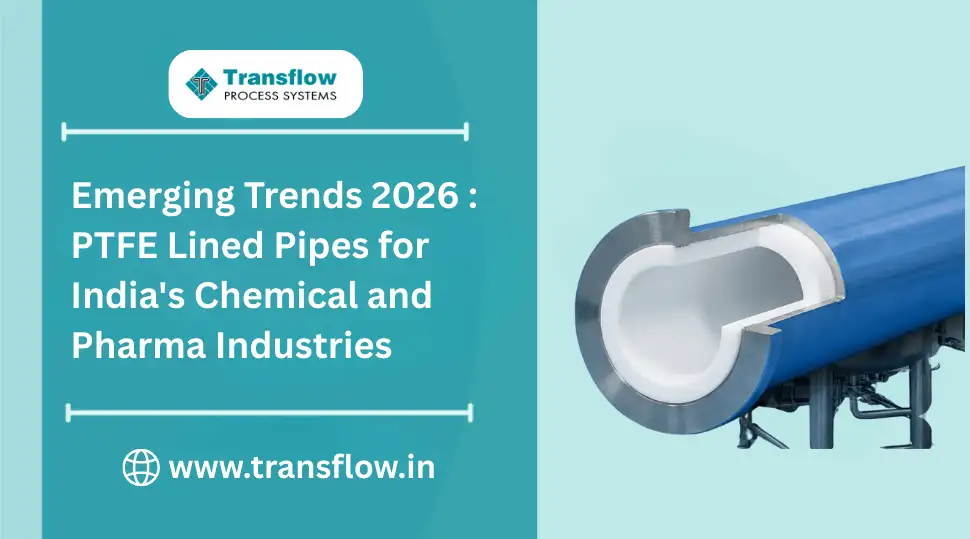
By the end of 2025, the India chemical and pharmaceutical industries have found
themselves at a crossroads.
Chemical industry with a value of approximately 250 billion in 2024 is projected
to reach 300 billion in 2028.
Growth projections are not very high as it is projected at 1.9 in 2025 and 2 in
2026 due to the capacity of the
world. Exports Pharma exports jumped to a record high of $30.47billion in FY25,
9.4% year-to-year. FY26 is
projected to be approximately $30.5 billion, with a 10% CAGR on revenue
projected thereafter.
This momentum underscores a core need: reliable, corrosion-resistant fluid
handling for acids, solvents, and
APIs that powers everything from Gujarat refineries to Hyderabad cleanrooms
(References)
The pipes are made of steel outer covering and smooth polytetrafluoroethylene
inner coverings. They provide
compliance to 98 % of chemicals, heat resistance to 260°C, and a life cycle of
15-20 years. The global market
expanded to $1.8 billion in 2024 and is expected to expand to 2.93billion in
2032, with 6.3% CAGR. These systems
are changing dynamically in India where chemical processing contributes 40% of
the Gujarat output.
The efficiency and compliance are going to be reshaped by three trends,
including sustainability, integration
of IoT, and hyper-customization by 2026. This guide covers those trends based on
facts and practical
suggestions to enable you settle on upgrades that reduce the prices and risks.
(References)
Market Snapshot: Steady Growth Amid Headwinds
The chemical industry in India has reached an estimated 300-400 billion dollars
by 2030 thanks to PLI schemes
and export incentives, which began growing in the industry, up to 220 billion in
2023. However, 2026 predicts
the muted future, with the world production dwindling to 1.5% since energy
volatility and tariffs have affected
the world. Pharma, in its turn, is doing well, with almost $30billion in exports
and CRDMOs driving further
innovation. (References)
The demand of PTFE will be on the rise in the major centers of India. The
segment of fluoropolymer is expected
to attain to 2.236 billion dollars worldwide in 2025 and to 3.479 billion in
2035. In India, 6.3 million
dollars of the chemical were used in 2025 and the prediction was 10 million
dollars in 2034. Stricter BIS
regulations, humid climates that promote corrosion and a transition to
zero-leakage as a requirement of ESG
are drivers. By using modern linings, facilities have noted a 30 per cent
reduction in maintenance which is
essential as CAPEX is increased in Vapi and Ankleshwar. (References)
Tip : Assess waste streams now; pilot eco-upgrades on high-volume pipes
for 18-month ROI.
Trend 1: IoT Integration – Predictive Power for Uptime
Industry 4.0 introduces IoT sensors into the linings of PTFE, pH, pressure, wear
sensors through SCADA
connections. This is because predictive data can reduce risks of contamination
within the pharma cleanrooms by
up to 50%. Chemical plants can reduce 35% of hydrocarbon leakages at 260°C and
the deployments of 5G networks in
Vadodara reduced the cost of retrofitting by 25%.
The intelligent segment is aimed at 7% CAGR, which uses innovations such as
AI-thinned linings. This is on the
basis of a Maharashtra pharma customer who integrated patent-707 sensors with
Transflow in the last quarter and
saved 28% of the downtime. These sensors should be used in combination with
Transflow lined valves to be fully
visible. (References)
Tip: Target volatile lines for pilots expect 20% energy savings from flow
optimization.
Trend 2: Hyper-Customization – Fitting India's Diverse Realities
Normal pipes will route through monsoons, dust, and seismic areas of India in
2026, it will require custom
designs, such as seismic resistance of Maharashtra, anti-fouling of coastal
locations, and modular designs to
redesign pharma.
Extrusion speed can also be sped up by 40% with precision extrusion, which is
essential in oil-and-gas lines.
Quick swaps in pharma ensure US FDA purity. High standards of hygiene are
required in food processing; the
lifespan of food in humid conditions can be doubled by custom-made systems.
The prototypes of Transflow are 1/2 till 24 inches, and Y-type strainers to
control debris. Hyderabad project
recorded an increase of throughput by 15%.
Tip: Map site-specific risks; use 3D modeling to avoid overspend.
(References)
Real-World Wins and Next Steps
These trends converge for big impacts: Gujarat chemicals save $500K/site yearly
on leaks, pharma yields hit
99.9% via low-friction customs. A Vadodara upgrade blended all three, trimming
waste 22% and installs 50%.
Prep with: Media audits (PTFE for acids; PVDF insights), BIS checks, and phased
IoT. For bends, see elbows guide.
Transflow: Innovating for Your Edge
Since 2006, Transflow's ISO 9001:2015 solutions—pipes, check valves—serve 700+
clients like Reliance. Our
non-adhesive tech and beta IoT/eco lines future-proof flows.
Forward to 2026: Act Now
Amid 2% chemical growth and $30B+ pharma exports, PTFE trends offer resilience.
Embrace them to thrive.
Consult Transflow at info@transflow.in—free audits await.
Explore
transflow.in. What's your
priority trend?