



25
May
May
MS PTFE Lined Bends and MS PFA Lined Tees in Chemical Piping Layouts
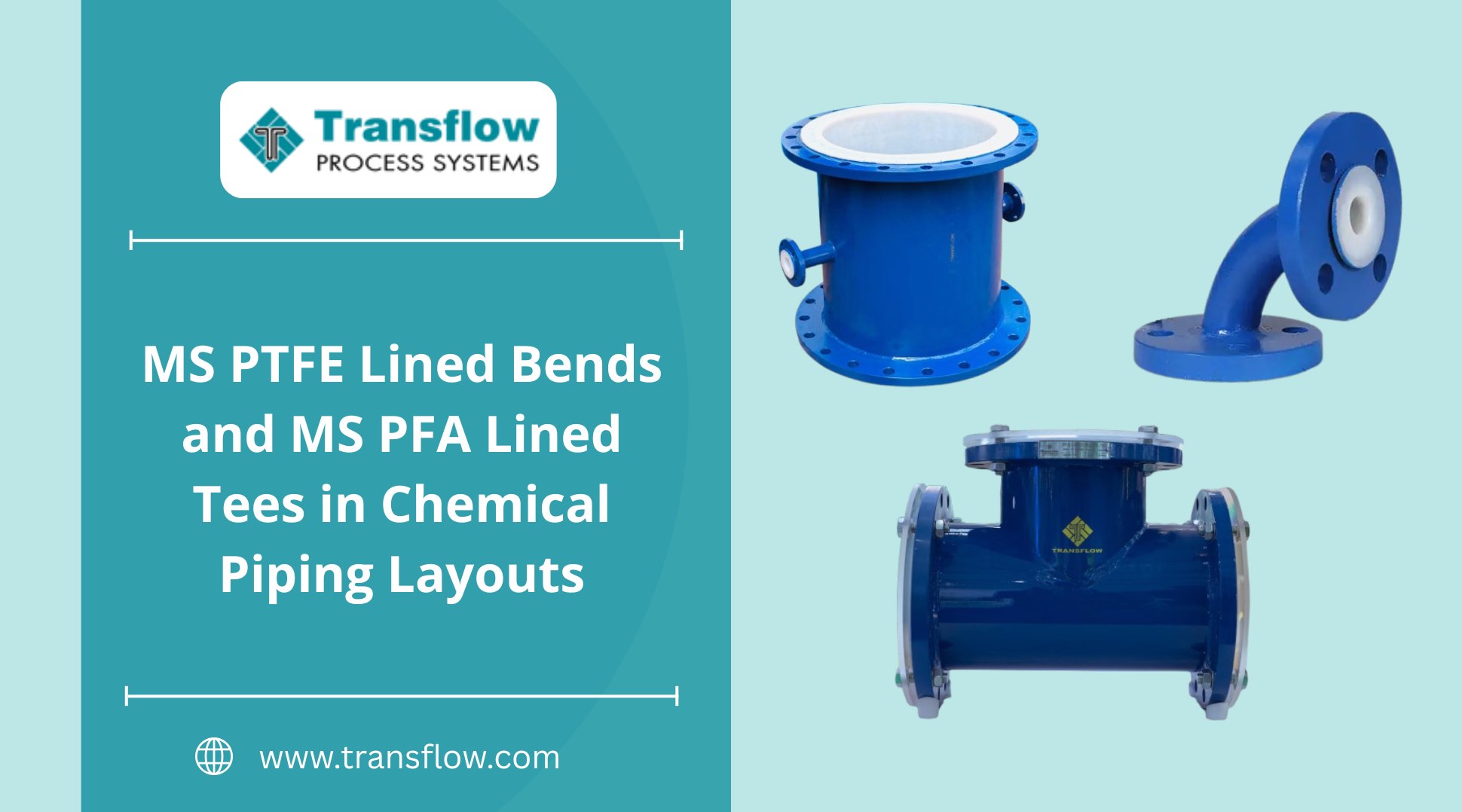
Safe fluid transit in corrosive piping systems takes more than just straight
runs. The real stress happens when flow changes direction or splits.
We manage these high-stress conditions using MS PTFE lined bends and MS PFA
lined tees, which push aggressive media through complex layouts without letting
it touch bare metal.
How Flow Is Managed in Chemical Piping Layouts
The lifespan of any chemical piping system depends heavily on how you control
these transition points.
Flow Behavior in a Piping System
Straight flow is easy. As long as aggressive media runs uninterrupted through
straight pipes, internal pressure and velocity stay stable.
But plant layouts aren't simple grids. You have to route around infrastructure
or feed multiple reactors, which means diverting or splitting the flow. That
necessary disturbance shifts the velocity and immediately applies mechanical
stress to the line.
Where PTFE Lined Bends Are Used?
You handle directional changes with a PTFE
Lined Elbow 45° / 90°. A 90° bend forces a sharp turn, usually needed to
get around tight structural grids or equipment layouts.
A 45° bend offers a softer transition. This gentler angle keeps
momentum steady to minimize sudden pressure spikes in highly turbulent flow
systems. It comes down to basic physics: the sharper the bend, the harder the
impact force on the outer wall, which drives up stress concentration in
corrosive service.
Where PFA Lined Tees Are Installed ?
When one source needs to feed multiple lines, you need active branching. A Lined Equal / Unequal Tee splits the main line,
distributing process fluid into secondary networks.
These components are vital for ensuring that flow distribution remains
controlled without causing a pressure imbalance across downstream lines.
What Happens at Direction Change and Branch Points ?
Flow doesn't fail randomly. It fails where it changes.
Whenever heavy fluid hits the wall of a bend or branch, it
triggers immediate turbulence and severe stress concentration. The kinetic
energy of the moving fluid has to be absorbed and violently redirected.
That drastic shift in momentum makes transition zones the most
volatile parts of any chemical piping system.
Why These Points Fail Without Proper Lining ?
Leave a junction unlined in aggressive media, and it degrades fast. The mix of
chemical attack and physical turbulence causes rapid localized erosion.
Once the wall thins out at a branch or turning point, the risk of
a catastrophic blowout spikes. This is exactly why transition points are always
the first locations to fail in poorly designed piping systems. A PTFE lined bend
stops this erosion by putting a tough, inert barrier right at the point of
maximum impact.
Design Advantages of Equal and Unequal Tees
Plant routing demands precise flow control at every split. Equal tees keep flow
volume balanced across all three ports to maintain pressure uniformity.
Unequal tees step the flow size down right at the branch. Dropping in an unequal
tee removes the need for an extra Concentric / Eccentric Reducer. Eliminating
that reducer cuts down the number of flanged joints and fewer joints mean fewer
potential leak paths.
Material and Construction Considerations
Mild Steel (MS) is the standard housing material for typical
indoor plant pressures. If the plant deals with harsh atmospheric conditions or
outdoor exposure, housings are upgraded to Carbon Steel (CS) or Stainless Steel
(SS).
As established providers of Lined Pipes Fittings and Valves in
India, we ensure these exterior modifications never alter critical ANSI flange
compatibility. This guarantees a continuous, unbroken lining across the entire
network.
Manufacturing and Lining Integrity
A fitting's internal geometry has to be flawless to survive
high-turbulence zones.
We rely on a Unique Lining Process that ensures the fluoropolymer
maintains an absolutely uniform thickness, even across the sharpest corners of a
bend or tee. This is critical at high-stress corners where uneven lining can
lead to premature failure.
As a dedicated Unique Lining Process Manufacturer in India, our
method leaves zero residual stress inside the plastic matrix. This prevents the
liner from collapsing or deforming during severe vacuum conditions.
Where This Layout Is Used ?
You will see this level of routing integrity wherever standard
alloys get eaten alive by directional stress.
A PFA lined tee and lined bend setup is standard across critical
industrial environments, including:
- Bulk chemical manufacturing
- Acid regeneration plants
- Mixed effluent handling facilities
Active Pharmaceutical Ingredient (API) plants also depend heavily
on this configuration, as the smooth internal geometry secures high purity and
zero cross-contamination.
What Defines a Stable Piping Layout ?
A stable chemical piping system comes down to how smoothly it
manages directional changes and fluid distribution.
When transitions are managed using compatible lined components,
stress concentrations are reduced and system reliability improves significantly.
System weak points are engineered out, securing long-term operational safety and
predictable flow performance.
For project-specific routing requirements, Transflow supplies MS,
CS, and SS lined fittings with engineering support based on exact plant
conditions.
Contact our team to discuss your requirements: