



15
June
June
Operational Challenges of Lined Y-Type Strainers in Corrosive Service
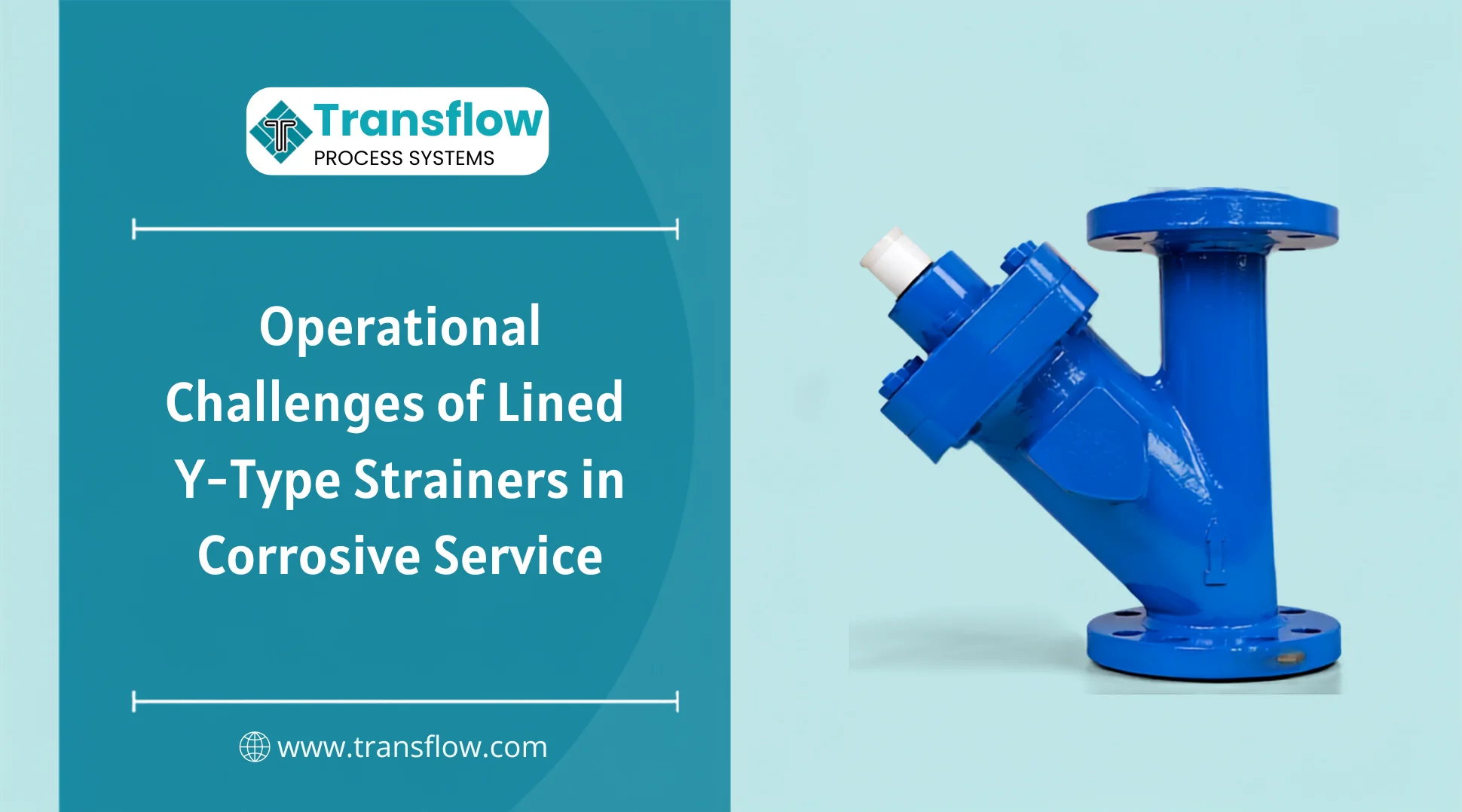
Most process lines run perfectly fine on the surface, but underneath, things are
constantly moving. A pump seal wears out months before its scheduled
replacement, or a control valve starts passing because the seat got scored.
You look at the logs, check the instrumentation, and everything seems normal.
Usually, the culprit is something simple that was traveling through the straight
pipe runs a flake of scale, a piece of an over-torqued gasket, or solid debris
just moving with the flow until it finds a tight clearance.
Why Do Strainers Create Their Own Problems?
To protect downstream equipment like pumps and control valves from solid
particulates, facilities place a trap in the line. That is the only reason a Lined
Y-Type Strainer ends up in the layout. However, catching those solids
creates an entirely new set of daily operational headaches.
What Happens as the Screen Starts Loading?
The screen does its job, but as it fills up, the flow changes. You start seeing
a pressure drop across that section of the pipe. If operators aren't monitoring
differential pressure, that restriction silently turns into a major bottleneck.
Conversations about reliability in corrosive service usually focus on thermal
cycling or permeation, yet mechanical damage from ignored debris or pressure
spikes caused by a completely plugged screen can be equally destructive. Many of
these failure mechanisms become easier to understand when looking at why lined piping systems fail in corrosive
service.
What Happens When It's Time to Clean the Strainer?
Eventually, the pressure drop becomes too high, and someone has to
pull the mesh. If the line is running cooling water, pulling a screen takes
twenty minutes, but if that pipe is handling hot acids, solvents, or aggressive
fluids, cleaning the trap quickly becomes a hazardous operation.
Why the Cleaning Sequence Matters ?
While cleaning a strainer sounds simple on paper, on the plant
floor, the sequence matters:
- Securely isolate the line to prevent accidental exposure.
- Safely drain the trapped, corrosive media into a designated collection point.
- Open the housing to the atmosphere without causing a spill or vapor release.
- Clear the mesh, inspect the internal surfaces, and bolt everything back together securely.
Material Choice Matters During Repeated Maintenance
Repeated cleaning cycles place their own structural demands on the equipment. At
the same time, the area around the screen sees the highest disturbance,
especially once solids begin collecting.
If the housing is bare metal, that turbulence combined with acidic media will
quickly eat right through the casting.
When the fluid itself is highly corrosive, plants often rely on a
PTFE Lined Y-Type Strainer, although PP Lined Y-Type Strainer, PVDF Lined Y-Type
Strainer, and HDPE Lined Y-Type Strainer configurations are also used depending
on process requirements.
Not because it improves flow. But because the internal lining
protects the strainer housing from chemical attack, ensuring it survives years
of draining, cleaning, inspection, and reassembly without becoming a maintenance
problem of its own.
Companies supplying Lined Pipes, Fittings, and Valves in India see
these same maintenance patterns repeatedly, especially in chemical service where
lined piping systems are expected to withstand years of cleaning cycles and
routine operation.
Do These Challenges Change Across Applications?
The applications change, but the maintenance realities remain
surprisingly similar. Whether the service involves bulk chemicals or
pharmaceutical processing, the operating principles remain identical.
That is also reflected in the wide range of y-type strainers used in the chemical & pharma industry,
where protecting downstream equipment remains a common requirement.
The day-to-day reality, however, rarely changes. Operators need to
know they can pull the screen safely, and they need confidence that when
everything is bolted back together, the line will hold pressure.
What Defines a Reliable Filtration Point?
If you manage the pressure drops and plan the cleanouts properly, these
strainers support cleaner process conditions without exposing the pipeline to
unnecessary degradation.
The downstream equipment stays protected, and perhaps most
importantly, the entire system runs with fewer surprises.
If pressure losses or repeated cleaning cycles are becoming
familiar problems in your facility, it may be time to take a closer look at the
filtration point itself.
Contact us to
discuss suitable solutions for corrosive service applications.