



09
Oct
Oct
PTFE vs PFA vs FEP: Which Fluoropolymer Product is Right for Your Process Industry?
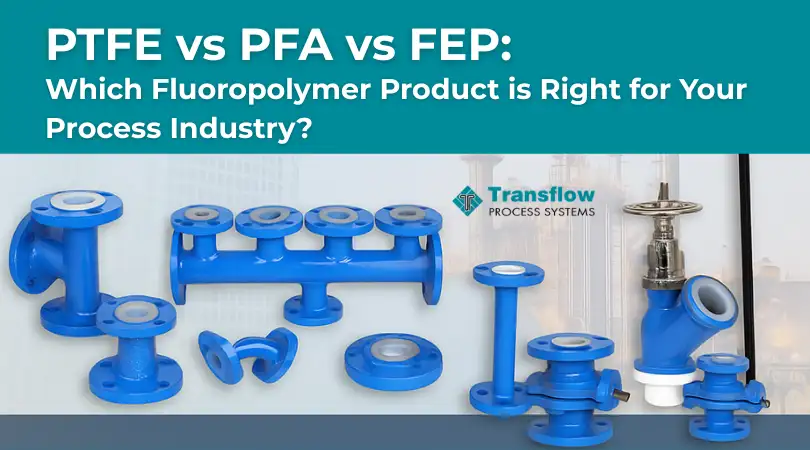
In the industrial world, reliability and precision are everything.
Choosing the right fluoropolymer material can highly impact on how your systems
operate efficiently & safely, whether you are managing a dairy facility in
Vadodara, a chemical plant in Ankleshwar, or a pharmaceutical unit in Ahmedabad.
For many decision-makers, this question often comes to their mind: Which should I choose, PTFE, PFA, or FEP for my process requirements?
For many decision-makers, this question often comes to their mind: Which should I choose, PTFE, PFA, or FEP for my process requirements?
Before jumping to know about each of these fluoropolymer products. you need to
understand the real differences that help you optimize performance, purity, and
cost-efficiency. That’s what you will learn in this blog, where we will guide
you to everything that allows you to make smart decisions at the end.
Let’s get started!
Let’s get started!
What are Fluoropolymers & Why They Matter?
Before comparing materials, you should know what fluoropolymers are
Fluoropolymers are high-performance, advanced plastics which have been designed
to withstand corrosion, chemical reaction, and extreme temperatures. These
materials are non-sticky, chemically resistant, and heat stable; all this has
made them invaluable in the current process industries.
However, PTFE, PFA, and FEP help you in safeguarding your systems and ensuring
long-lasting dependability, from transferring strong acids in chemical plants to
bringing purity in pharmaceutical applications.
Key Differences: PTFE vs PFA vs FEP
PTFE (Polytetrafluoroethylene )
PTFE is the most commonly known fluoropolymer, which has an unsurpassable
chemical resistant nature and ability to withstand high temperatures (around
-200°C to +260°C). Its exposure is non-reactive, non-sticky causing it to be
ideal when dealing with aggressive acids, alkalis, and solvents.
- Perfect For: Chemical, Oil and Gas and Corrosive Media Transfer.
- Weaknesses: Not readily meltable; less supple
PFA (Perfluoroalkoxy)
PFA is a mixture of the chemical resistance of PTFE with flexibility of a
thermoplastic. It is melt-processable, clear, and provides ultra-clean operation
- this is why it is the best choice when pharmaceutical or semiconductor
applications are required
- Strengths: Smooth lining, very pure and good heat resistance
- Industries: Pharma, Biotech, Semiconductor, and High-Purity Fluids.
- Limitations: More expensive, a little less mechanical strength as compared to PTFE.
FEP (Fluorinated Ethylene Propylene)
FEP is prized due to its flexibility, transparency, and electrical insulation
qualities. It is also effective in moderate chemical exposure; it melts easily.
Hence, it is appropriate to use in food, dairy, and general industrial
applications.
- Strengths: Cost-effective, flexible, UV stable and transparent
- Use: Food, Dairy, and Dilute Chemical Processes
- Limitations: Minimum upper temperature (around 200°C)
Comparative Analysis: PTFE vs PFA vs FEP
| Property | PTFE | PFA | FEP |
|---|---|---|---|
| Max Temp Resistance | Up to 260°C | Up to 260°C | Up to 200°C |
| Processability | Non-melt | Melt-processable | Melt-processable |
| Flexibility | Rigid | Flexible | Highly Flexible |
| Chemical Resistance | Excellent | Excellent | Very Good |
| Purity | High | Ultra High | Moderate |
| Cost | Moderate | High | Affordable |
PTFE is the champion in the case of industries that need high
levels of chemical and temperature resistance. PFA is the best choice when it
comes to purity and clean-room requirements. In the meantime, FEP is a great
value provider when it comes to flexibility and cost-efficiency.
Key Factors to Consider Before Choosing Your Fluoropolymer
Selecting an appropriate fluoropolymer is not only a technical choice only, but
also a strategic choice. Just think of your process system as a frontline
soldier, it can only work out to the level of the armor it wears.
First of all, check for chemical compatibility - Is it compatible with your
acids and solvents? then gauge temperature and pressure parameters- will it
endure the heat of your operation? For industries like pharma or food, purity
comes at top priority. And, lastly, consider the cost versus life cycle - what
costs you currently can afford may end up costing you more in the future. It’s
not just the right fluoropolymer that lasts longer, it offers you a continuous
production process without once breaking.
Bonus Tips: Industry-Wise Recommendation Guide
- Chemical Industry: PTFE that can resist corrosion and acid like no other.
- Pharmaceutical & Biotech: PFA to be pure, clean, and compliant.
- Food & Dairy: Hygiene and flexibility at moderate conditions FEP.
- Oil & Petrochemical: PTFE or PFA thermal endurance, reliability
- Water Treatment: FEP or PTFE to deal with acid/alkali mixture
Conclusion:
PTFE, PFA, and FEP are all a matter of choice, which is based on your process
needs - chemical resistance, purity, temperature constraints, and flexibility.
However, if you want a perfect solution for extreme chemicals & high
temperatures, that’s where PTFE comes in. But you are looking for flexible and
pure applications, so you find PFA as a right choice, and lastly, if you need a
solution that contains cost-efficient requirements with general purpose, then
FEP could be a good option for you.
At Transflow, we have decades of experience in providing fluoropolymer products that satisfy the performance criteria across the world. Whether your company belongs to Dairy, Chemical, Oil & Petrochemical, Pharmaceutical or processing industries across India, going with us means bringing durable, compliant, and efficient solutions.
At Transflow, we have decades of experience in providing fluoropolymer products that satisfy the performance criteria across the world. Whether your company belongs to Dairy, Chemical, Oil & Petrochemical, Pharmaceutical or processing industries across India, going with us means bringing durable, compliant, and efficient solutions.
Looking for the perfect fluoropolymer solution for your process system?
Contact Transflow today to get expert guidance and
discover the right PTFE, PFA, or FEP product for your operations.