



25
April
April
When to Use Lined Equal / Unequal Tees in Corrosive Chemical Systems ?
Flow doesn’t stay uniform at a branch.
The fluid hits the junction, the velocity shifts, and the media splits. That
specific branching point takes constant mechanical stress. If that fluid is
highly corrosive, the inner wall of the fitting experiences accelerated wear.
Over time, standard branching points become the most frequent sites for
maintenance and replacement in the pipeline.
Why standard branching points fail first?
A standard metal fitting handles line pressure, but it struggles to resist
chemical attack at the branch.
The fluid changing direction creates localized turbulence. This turbulence
strips the natural protective layer off standard metals. Once that bare surface
is exposed to aggressive solvents or acids, the fitting degrades. You end up
replacing the exact same piece repeatedly because the base material cannot
handle the localized stress.
How a lined tee changes the pipeline?
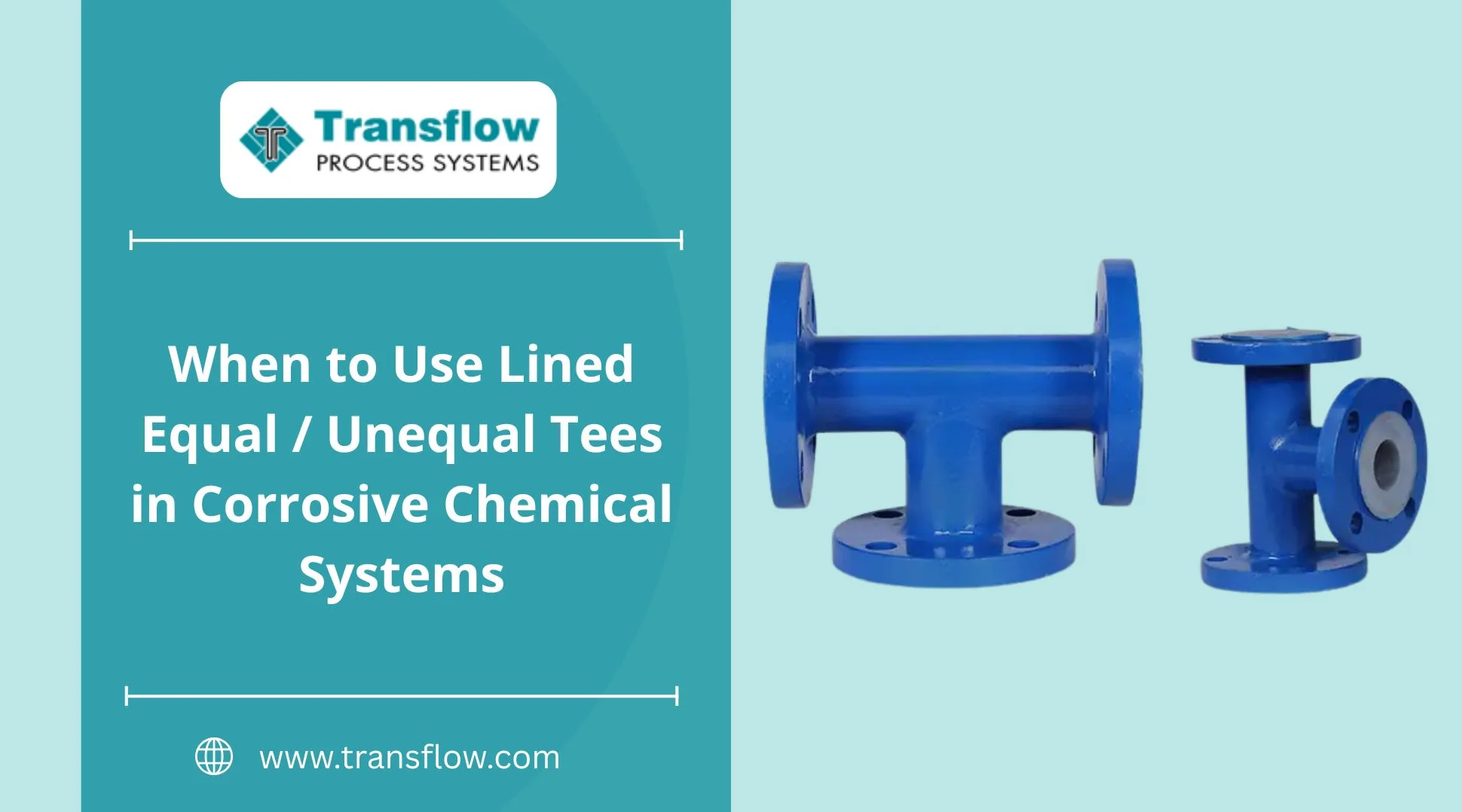
That is exactly where a Lined Equal /
Unequal Tee changes the setup.
It separates the physical pressure of the system from the chemical reality of
the fluid. The fitting provides the rigid pressure retention of a solid metal
casting, but the media is isolated from the metal by a polymer liner. It acts as
a critical reinforcement point for Corrosion Resistant Piping Systems.
Because these fittings use standard face-to-face dimensions, they
act as direct drop-in replacements. You bolt them right up to your existing
flanges without modifying your pipework.
What is actually happening inside the housing ?
The outer housing takes the stress. It is cast from solid Ductile
Iron (ASTM A395) or Cast Carbon Steel (ASTM A216WCB).
The inside is fully lined with fluoropolymers such as PFA or FEP,
which act as a highly resistant barrier. Transflow uses a Unique Lining Method in
their fully equipped in-house manufacturing facility. Instead of a conventional
transfer moulded system, they use a semi-automatic injection moulding machine
with an isothermal process.
During the entire moulding stage, the tooling assembly ensures the
internal mandrels stay perfectly centered inside the cast housing. This results
in uniform lining thickness across the tee and zero residual stress. The liner
fits closely inside the metal housing, which is necessary to prevent collapse
under high vacuum ratings.
Verifying the fitting before deployment
You don't guess if an Industrial Lined Tee will hold up when you install it. You
verify it.
Every single fitting undergoes strict quality testing before
leaving the floor:
- Spark Test: Subjected to 15 KV DC for non-vacuum applications to verify the integrity of the polymer.
- Hydro Test: Pressurized at 29 Kg/cm² for 3 minutes to guarantee the structural strength of the housing.
- Visual and Dimensional Testing: Ensuring precise compliance with standards for a seamless fit.
Every piece is hard-punched with the year, month, and serial
number for traceability, and ships with complete Material Test Certificates
(MTC) and Quality Control reports.
Where these fittings make sense ?
You use these fittings in Chemical Processing Systems where standard
metals degrade rapidly.
You install an equal tee to split an acid line into identical
streams, or an unequal tee to branch off a main header while stepping down the
line size. They integrate perfectly into full networks of Lined Pipes &
Fittings.
But this setup isn’t necessary for everything.
If you are running standard utility water or high-temperature
steam, a Lined Tee is an unnecessary cost. The polymer must also match
the exact process conditions.
Making the right call on maintenance
Branching points shouldn't dictate your maintenance schedule.
If the same junction keeps thinning out, leaking, and causing downtime, the material itself is likely the limitation. You have to look at the mechanical and chemical stress happening at that specific point. If the issue keeps showing up at that location, it's worth checking whether the fitting itself is the limitation . Contact us