



15
October
October
PTFE Lined Pipe Spool Manufacturing Process Explained?
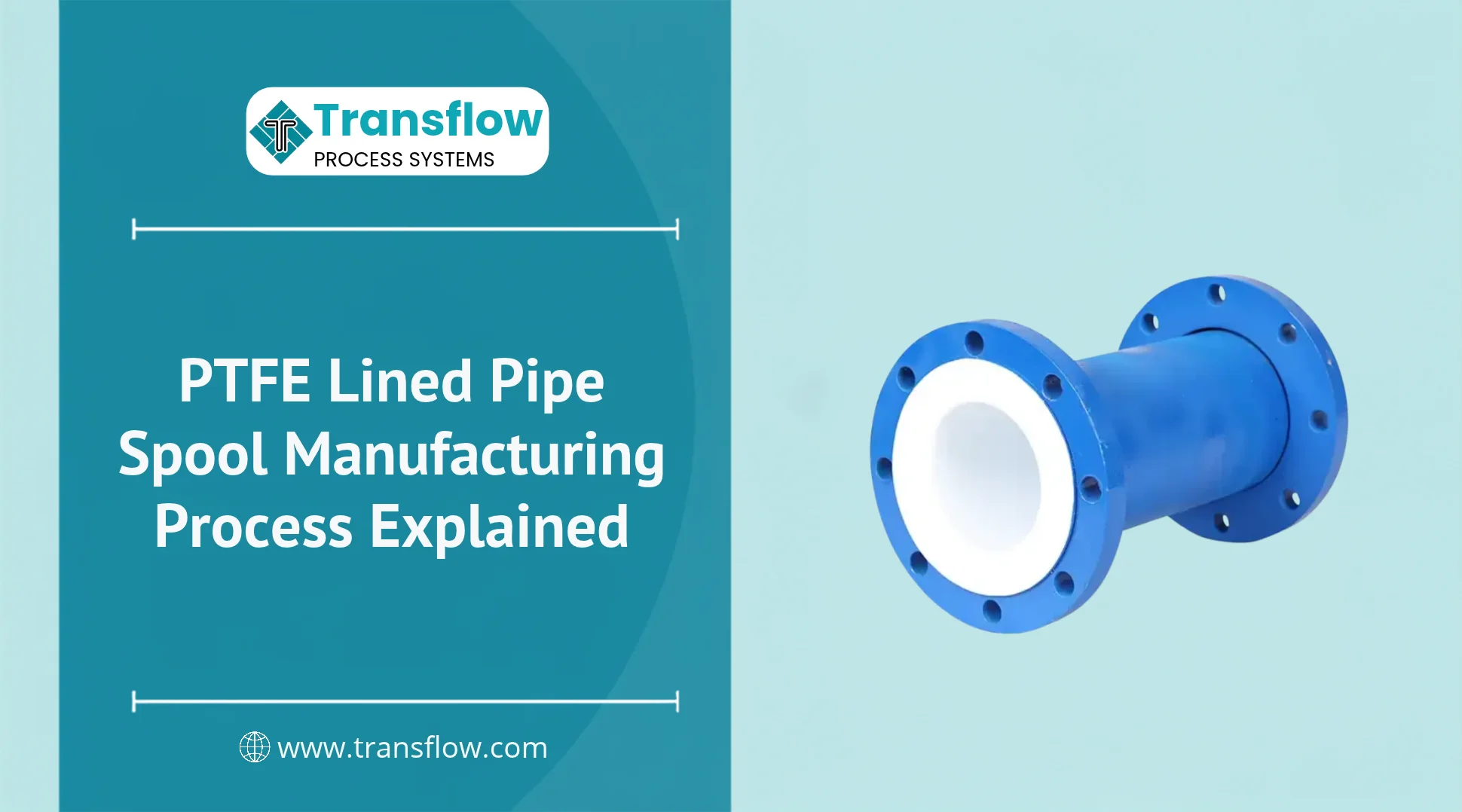
A lined pipe spool looks simple from the outside: a steel pipe with flanges at both ends. The
real work happens inside, where a fluoropolymer liner must sit tight against the steel and
stay sealed for years.
That liner keeps corrosive media away from the carbon steel. How well it is fitted, flared and
tested decides whether the spool lasts or leaks.
This guide walks through each stage, from raw materials to final inspection.
Core Components of a Lined Spool
Every spool has two parts working together. The steel shell carries pressure and mechanical
load, while the polymer liner handles the chemical attack.
Transflow’s lined pipe spool range is built from these core components:
- Seamless pipe: carbon steel to ASTM A-106 Gr B, Schedule 40 or 30.
- Flanges: carbon steel slip-on flanges to ASTM A-105 or IS 2062 Gr A, ANSI B16.5 Class 150.
- Lap collar: carbon steel, over which the liner is flared.
- Resin: PTFE to ASTM D 4895. The same spool can also be lined with PP, PVDF or HDPE.
Transflow also provides drawings for jacketed nozzle and nipple-end versions.
How PTFE Lined Pipe Spool Manufacturing Works?
The exact sequence varies between plants, but the general flow is consistent across the
industry.
It starts with the steel shell. Pipe is cut to the drawing length and fitted with flanges and
collars. Weld joints must be clean and smooth, since spatter or sharp edges inside the bore
can damage the liner.
The liner is made separately, commonly by extruding PTFE into a tube, and checked for
dimensions and surface condition before it goes near the steel. A tube sized for a snug fit is
then drawn into the pipe. The fit matters, because a loose liner is more likely to move or
collapse under temperature cycling or vacuum. Transflow’s lining process uses 100% PTFE
with no adhesive.
Next comes flaring. Both liner ends are heated until pliable, then pressed outward over the
flange face. This flared lip becomes the sealing surface when the spool is bolted to its
neighbour.
Finally, small vent holes are often drilled in the steel to release gas that permeates the liner,
which helps prevent collapse. Spools are then marked for traceability.
Testing Before a Spool Leaves the Plant
Inspection is where a lined spool proves itself. Transflow’s quality testing sequence covers:
- Visual and dimensional checks on each product before electrostatic and hydro testing.
- Spark test at 15 kV DC to ASTM F 1545, suitable for non-vacuum applications, which exposes pinholes or liner damage.
- Hydro test at 29 kg/cm² for three minutes, confirming leak tightness and weld strength.
Hard punch marks carry the year, month and serial number through production. Each
product also ships with Material Test Certificates and a QC report. Detailed test records are
maintained.
PTFE, Teflon and PFA Lined Options
Teflon is the brand name most people use for PTFE, so a teflon lined pipe spool is the same
product as a PTFE lined spool. You will often see both terms used interchangeably in
enquiries and drawings.
A PFA lined pipe spool differs in the liner material. PFA can be melt-processed, so its liners
are formed differently from paste-extruded PTFE. The right choice depends on media,
temperature and purity needs, as covered in PTFE vs PFA vs FEP .
Where Spools Fit in Chemical Transfer Piping?
In chemical transfer piping, spools form the straight runs between elbows, tees, reducers
and valves. Every part along the route needs the same lining protection, or the weakest
component sets the limit.
Many reliability problems described in how lined piping systems fail in corrosive service
come down to incompatibility within the system. Vacuum and temperature swings are the
usual stress points, so liner fit and venting matter most on those lines.
Choosing a Lined Pipe Manufacturer
Before placing an order, a few questions are worth asking any lined pipe manufacturer:
- Which standards apply to the steel, flanges and resin?
- Is every spool spark tested and hydro tested, and are records shared?
- Are jacketed spools or PP, PVDF and HDPE linings available?
- Do material certificates and QC reports ship with the order?
Clear answers show how consistent the manufacturing process really is.
For spool drawings, material options or a quotation, Contact Us to discuss your process
requirements.