



25
July
July
Designing Chemical Distribution Networks for Corrosive Process Systems
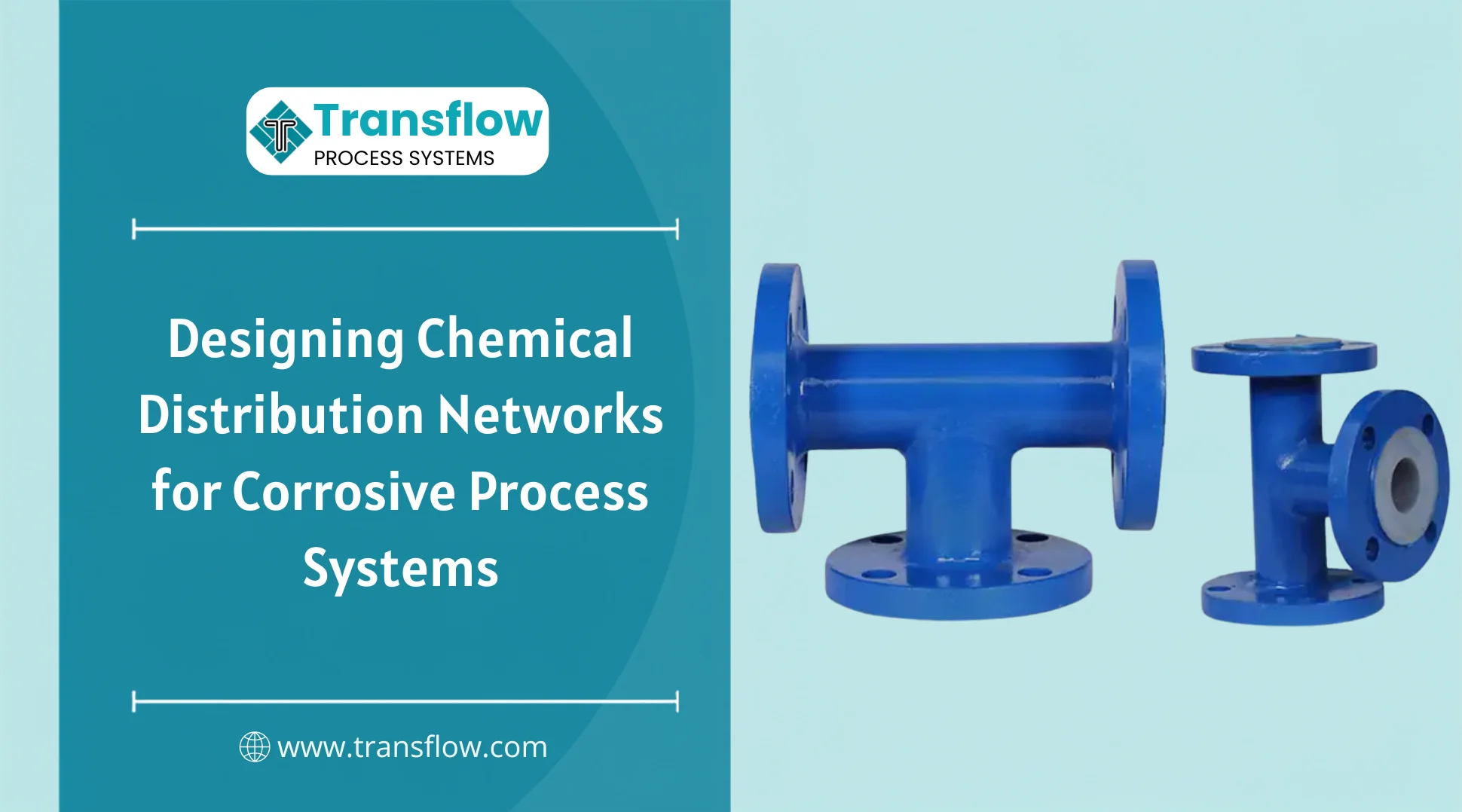
Chemical streams in a process plant rarely travel in a straight line. By the
time an aggressive solvent or acid leaves bulk storage, it typically needs to
reach multiple process units, intermediate vessels, and dosing stations
simultaneously.
The piping network has to divide, route, and manage this flow without
interruption. Designing these layouts means ensuring every branch connection
distributes corrosive media safely while keeping the overall process moving.
Understanding Chemical Distribution in Corrosive Process Systems
Modern chemical distribution systems operate as highly interconnected webs
rather than simple point-to-point transfers. A facility will often divide one
chemical stream between several operations without stopping production.
One utility line might feed aggressive media to multiple independent reactor
networks at once. Process piping manifolds actively split these flows to supply
dosing systems, while return lines consolidate any overflow back into bulk
storage.
Every branch point dictates how media routes across the network. This involves
far more than simply connecting pipelines.
Plant stability relies heavily on how well these junctions are engineered to
maintain predictable flow distribution across all downstream destinations.
Key Considerations When Designing Chemical Distribution Networks
Designing these layouts requires strict engineering attention exactly where the
flow splits. A branch might require equal distribution across uniform pipe
diameters. Conversely, a transition might be necessary to step down the flow for
specific volume requirements.
Handling aggressive process media requires applying even greater attention to
these design decisions.
Branch connections demand careful evaluation in corrosive piping because they
force changes in both flow direction and distribution within the same junction.
If that connection cannot maintain chemical resistance during flow division, the
reliability of the overall network can be compromised.
The Role of Lined Equal and Unequal Tees in Chemical Distribution
Distribution networks inherently require controlled branching. To manage branch
flow and mixing securely, engineers commonly integrate a Lined Equal / Unequal
Tee. These components serve as the primary intersections within chemical
distribution systems.
Depending on the layout requirements, an industrial PTFE/PFA/HDPE Lined Equal /
UnEqual Tee can maintain consistent pipeline sizing across a branch, while
unequal configurations accommodate necessary transitions between different pipe
diameters.
Securing multi-directional connections without exposing the
structural metal housing to the media allows a PTFE LINED TEE to safely support
high-purity chemical handling and dosing operations.
Supporting Components in Chemical Distribution Networks
Complete manifolds rarely rely on just one type of branch connection. Some
layouts require fluid distribution across four connected pipeline directions
from a single central junction.
A Lined Equal Cross serves as that necessary hub. It
divides or
combines flow in complex multi-line process networks while keeping media
movement steady.
Routing lines through dense facility footprints also forces frequent directional
changes.
A Lined Elbow 45° / 90° accommodates these turns within
the piping layout while
keeping the corrosive process media entirely on a lined flow path.
These fittings help create the complete branching and routing layouts discussed
in MS
PTFE Lined Bends and MS PFA Lined Tees in Chemical Piping Layouts.
Building Reliable Chemical Distribution Networks for Corrosive Service
Chemical distribution system stability depends on selecting compatible,
engineered components that protect the fluid path from end to end.
Sourcing reliable Lined Pipes, Fittings and Valves in India requires evaluating
how these branching and routing components function together as a unified
system.
Integrating compatible lined components throughout the network helps maintain a
continuous, corrosion-resistant flow path even where branches and directional
changes occur.
Facilities can avoid many long-term operational issues by understanding Why
Lined Piping Systems Fail in Corrosive Service and addressing those
vulnerabilities directly at the manifold level.
Well-planned distribution networks depend on much more than a single fitting.
They rely on compatible lined components working together to support safe
routing and long-term operation in corrosive process environments.
If your process requires a reliable chemical distribution network for corrosive
service,
Contact Us to discuss lined piping solutions tailored to your application.